Systemische Neurobiologie
Grothe-Lab

Grothe-Lab

© Carolin Bleese
Inhaber des Lehrstuhls für Neurobiologie (seit 10/2025 beurlaubt)
&
LMU Vizepräsident ür Natur- und Lebenswissenschaften und Stellvertreter des Präsidenten
Mitglied der Bayerischen Akademie der Wissenschaften (BAdW)
Mitglied der Deutschen Akademie der Wissenschaften, Leopoldina
+49 89 2180-3269 (Frau Kiesl, Sekretärin Präsidium)
Präsidium
Ludwig-Maximilians-Universität München
Georgenstraße 7
80779 München
Benedikt Grothes primäres wissenschaftliches Interesse gilt dem mechanistischen Verständnis der Signalverarbeitung im Gehirn von Säugetieren. Seine Forschungsgruppe hat die Struktur, Physiologie, Funktion, Evolution und Entwicklung des auditorischen Systems von Säugetieren analysiert. Die Gruppe hat mehr als 150 wissenschaftliche Arbeiten veröffentlicht, die sich mit der präzisen Verarbeitung zeitlicher und räumlicher auditorischer Signalparameter sowie deren Dekodierungs- und Kodierungsprinzipien entlang des aufsteigenden Hörwegs (vom auditorischen Hirnstamm bis zum Kortex) befassen.
Zu den im Labor verwendeten Methoden gehören In-vitro- (akute Hirnschnitte) und In-vivo-Elektrophysiologie, oft in Kombination mit Neuropharmakologie (Mikroiontophorese, Laser-Uncaging usw.), Optogenetik, vergleichender Anatomie, Immunhistochemie, In-vivo-Ca²⁺-Bildgebung, Modellierung sowie Tier- und Humanpsychophysik.
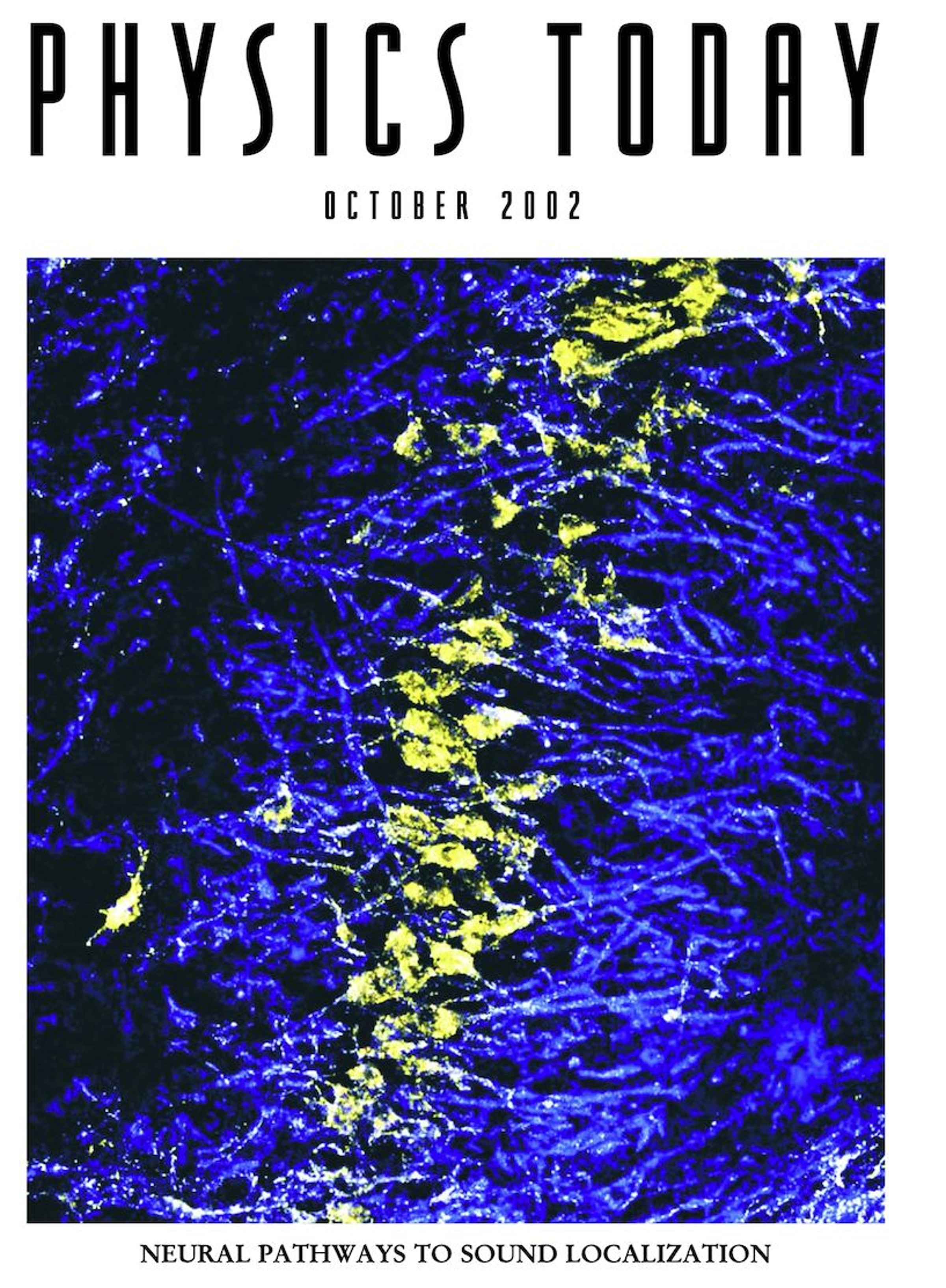
Arrangement of functional inputs to the medial superior olive (MSO), the structure that encodes differences of the arrival of sounds at the two ears with microsecond precision. MSO neurons are labeled in blue (MAP2), glycinergic (inhibitory) inputs are shown in yellow (glycine receptor antibody staining). Scale bar: 100 μm.
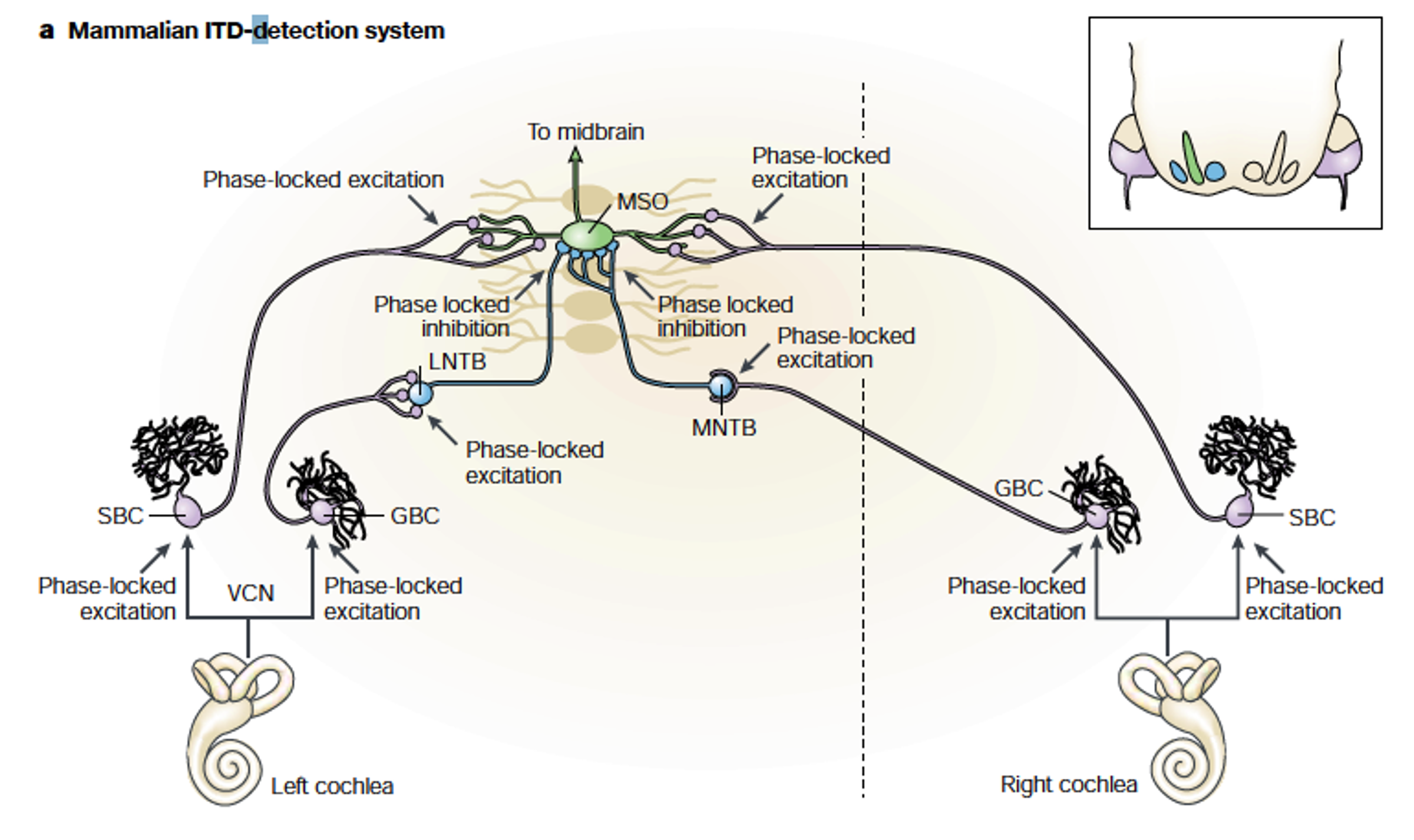
The interaural time difference (ITD)-encoding systems in mammals: The mammalian ITD encoder is the medial superior olive (MSO), an auditory brainstem structure (inset). MSO neurons are bipolar and their somata are arranged in one parasagittal plane. Excitatory projections originate from the left and right cochlea. Auditory nerve-fibre discharges time-lock to the stimulus onset or phase-lock to ongoing pure tones up to about 2 kHz. They excite spherical and globular bushy cells (SBC and GBC, respectively) in the ventral cochlear nuclei (VCN). SBCs and GBCs also provide phase-locked excitation to their targets: SBCs project to the MSO on both sides, GBC cells to the contralateral medial nucleus of the trapezoid body (MNTB) and the ipsilateral lateral nucleus of the trapezoid body (LNTB). The inputs to MNTB and LNTB are specialized to preserve temporal information: the MNTB is driven by a gigantic synapse, the calyx of Held. MNTB and LNTB neurons provide phase-locked, glycinergic, hyperpolarizing inhibition to the ipsilateral MSO. MSO neurons extract the ITD from a comparison of their four inputs and project to higher auditory centres. The well-timed inhibition is crucial for adjusting the ITD sensitivity of MSO cells to the physiological relevant range of ITDs.
Benedikt Grothe studierte Biologie und Psychologie an der Ludwig-Maximilians-Universität München (LMU). Nach seiner Promotion in Neurowissenschaften wurde er Kurator am Museum Mensch und Natur, einem Naturkundemuseum in München. Anschließend wechselte er als Postdoktorand in das Labor von George Pollak an der University of Texas in Austin und später in das Labor von Dan H. Sanes am Center for Neural Sciences der New York University (NYU). Von 1994 bis 1998 war er Assistenzprofessor am Zoologischen Institut (LMU). Von 1999 bis 2003 leitete er eine unabhängige Forschungsgruppe am Max-Planck-Institut für Neurobiologie in Martinsried. Seit 2003 ist er Lehrstuhlinhaber für Neurobiologie an der Fakultät für Biologie der LMU. Er gründete das Munich Bernstein Center for Computational Neurosciences (BCCN) und das bayerische Eliteprogramm M.Sc. in Neurosciences. Außerdem gründete er das Munich Center for Neuroscience – Brain & Mind (MCNLMU) und die Graduiertenschule für Systemneurowissenschaften (GSNLMU), die im Rahmen der deutschen Exzellenzinitiative ins Leben gerufen wurde. Von 2010 bis 2022 initiierte und leitete er den DFG-Sonderforschungsbereich CRC870 „Assembly and Function of Neuronal Circuits”. Er war Max-Planck-Stipendiat (2015-2025) und ist Mitglied sowohl der Bayerischen Akademie der Wissenschaften (BAdW) als auch der Deutschen Akademie der Naturforscher Leopoldina.
Benedikt Grothe war Direktor des LMU-Instituts für Biologie II sowie Prodekan und Dekan der LMU-Fakultät für Biologie.
In Anerkennung seiner herausragenden Beiträge zur Neurowissenschaft wurde ihm 2010 das Bundesverdienstkreuz verliehen.
Seit Oktober 2025 ist er von seinem Amt als Lehrstuhlinhaber für Neurobiologie beurlaubt und fungiert als gewählter Vizepräsident für Natur- und Lebenswissenschaften und stellvertretender Präsident der LMU.
Nabel AL, Teich L, Wohlfrom H, Alexandrova O, Heß M, Pecka M, & Grothe B (2024) Development of Myelination Patterns for Fast and Temporally Precise Auditory Signalling. GLIA 72:794-808
Ford MC, Alexandrova O, Cossell L, Stange-Marten A, Sinclair J, Kopp-Scheinpflug C,
Pecka M, Attwell D, & Grothe B (2015) Tuning of Ranvier node and internode properties in myelinated axons to adjust action potential timing. Nature Communic 25;6:8073
Grothe B, Pecka M, McAlpine D (2010) Mechanisms of sound localization in mammals. Physiol Rev 90:983-1012
Grothe B (2003) New roles for synaptic inhibition in sound localization. Nature Rev Neurosci 4: 540-550
Brand A, Behrend O, Marquardt T, McAlpine D, & Grothe B (2002) Precise inhibition is essential for microsec-ond interaural time difference coding. Nature 417: 543-547
Kapfer C, Seidl AH, Schweizer H, Grothe B (2002) Experience-dependent refinement of inhibi-tory inputs to auditory coincidence-detector neurons. Nature Neurosci 5: 247-253
Grothe B, Sanes DH (1994) Synaptic inhibition influences the temporal coding properties of medial superior olivary neurons: an in vitro study. J Neurosci 14:1701-9.
Grothe B, Vater M, Casseday JH, Covey E (1992) Monaural interaction of excitation and inhibition in the medial superior olive of the mustached bat: an adaptation for biosonar. Proc Nat Acad Sci USA 89: 5108-5112